'A second related point is that the media content endorses norms and values than larger societies.' The Contribution of Role Models to the Self Esteem of African-American and Caucasian Adolescent Girls. By Michelle p. Clarke "The traditional image of a 'wife-mother-housewife' is now being replaced by images of sexually assertive, confident and ambitious women who express their 'freedom' through consumption."
“The exemplary female prototype in advertising regardless or product or service, displays youth (no lines or wrinkles), good looks, sexual seductiveness, and perfection (no scars, blemishes, or even pores).”
Encyclopedia of Women and Gender: Sex Similarities and Differences and the Impact of Society on Gender Volume 1 by Judith Worell
"Specifically, women were portrayed in magazines in four recurring negative themes. (1) a woman's place is located within the home, (2) women do not make important decisions, (3) women are dependent and need a man's attention, and (4) men regard women primarily as sex objects."
"Print media like magazines also support early research on the negative portrayal of women."
"Continue to be portrayed in submissive positions to men, in unnatural poses, with sexually connotative facial expressions, and as the subject of violent imagery."
"Magazine representations of thinness have proven to be equally complicit in promoting eating disorder symptomatically."
Gender and The Media - Rosalind Gill
confident expressions of 'girl power' sit along side reports of 'epidemic' levels of anorexia and body dismorphia.
'A key feature od the gaze is that the object of the gaze is not aware of the current viewer (though they may have originally have been aware of being filmed, photographed, painted. The intentions and perception of the model. Notes on 'The Gaze' by Daniel Chandler to gaze implies more than to look at - it signifies a psychological relationship of poer, in which the gazer is superior to the object of the gaze' Audience Power Notes on The Gaze By David Chandler the look is a perceptual mode open to all whist the gaze is a mode of viewing reflecting a generated code of desire The difference between looking and gazing. *see reference above* some 'glamour' photographers to enhance their photographs in the same wayand thus to increase the attractiveness of the model. Distorting reality and the natural un-edited look. ** Where the female model typically averts her eyes, expressing modesty, patience and a lack of interest in anything else, the male model looks either off or up.
In the case where the model is looking up, this always suggests a spirituality ... he might be there for his face or body to be gazed at, but his mind is on higher things' The difference between how men and women are viewed from the same pose. ** male models feel bound to avoid the 'femininity' of being posed as passive object of an active gaze. Maintaining the stereotypical masculinity. **
American teen agers have chosen to be portrayed differently in their high-school yearbook0- the focus of their eyes has shifted from a straightforward, open look to a sideways glance, resembling glamour poses in fashion magazines. The effect of models on society and influence **
direct to the camera shot should connote directness of approach and it's attendant qualities of authority and reliability What Direct address should 'typically' connote.
the camera frequently enables us to look at people whom we would never otherwise see at all Opportunities that the camera gives the audience. **
the photographer (albeit temporarily) has power over those in front of the lens, a power which may also be lent to the viewers of the image. Manipulation by the photographer, not always down to the model in how they present themselves.
Photography promotes 'the normalising gaze, a surveillance that makes it possible to qualify, to classify and to punish. The manipulation can affect the model and the audience, and also influence.
'mirror and the camera are tools of self-reflection and surveillance. Each creates a double of the self, a second figure who can be examined more closely than the original- a double that can be alienated from the self- taken away, as a photograph can be, to another place' Model doesn't seem real, open to ridicule **
People have to look in order to be polite, but not look at the wrong people or in the wrong place. Social rule challenged.
Men look at women. Women watch themselves being looked at. How women are perceived. The differences between men and women. Objectification by men, accepting that objectification by women. the idea hat realistic 'highly tactile' depiction of things in oil paintings and later in colour photography (in particular where they were portrayed as 'within touching distance'), represented a desire to possess the things ((or the lifestyle) depicted. This is also applied to women depicted in this way. objectification
Women are still 'depicted in a different way to men- because the 'ideal' spectator is always assumed to be male and the image of the woman is designed to flatter him. Objectification passive. No purpose.
the pleasure involved in looking at other people's bodes as (particular, erotic) objects. In the darkness of a cinema auditorium is notable that one may look without being seen either by those on the screen by other members of the audience. Mulvey argues that that various features of cinema viewing conditions facilitate for the viewer both the voyeuristic process of objectification of female characters and also the narcissistic process ofidentification with an 'ideal ego' on screen. Why we objectify. Goals, ego boosting.
do not allow women to be desiring sexual subjects in their own right. Lacking power. Men do the looking; women are there to be looked at. Lack of power. Objectification.
the male is never sexually objectified in mainstream cinema. The difference between the uses of the gender in cinema.
there has been an increasing display and sexualisation of the male body in mainstream cinema and television and in advertising. Gender uses and views, changing over time.
we may 'identify' with feelings or experiences rather than characters as such. We may relate to their emotions, not necessarily objectify.
But high fashion models are generally unsmiling and sometimes openly contemptuous. So pronounced is this contrast that it is tempting to formulate it in a simple rule; the higher the fashion, the more sullen the expression. The supercilious expression on the models' faces serve to increase the desirability of what they're selling by evoking status anxiety in the viewer.
David Gauntlet : Media Gender & Identity Essay : Quotes
The traditional view of a woman as a housewife or a low-status worker has been kicked out of the picture by the feisty, successful 'girl power' icons. Changed perceptions
Magazines, bought on one level for a quick fix of glossy entertainment, promote self-confidence (even if they partly undermine it, for some readers at the same time) and provide information about sex, relationships and lifestyles which can be put to a variety of uses. Television programmes, pop songs, adverts, movies and the internet also provide numerous kinds of 'guidance' Magazine uses. purpose. Women's appeal.
Your life is a project- there is no escape. The media provides some of the tools which can be used to make it work. Media help.
the mass media has become more liberal, and considerably more challenging to traditional standards, since then, and this has been a reflection of changing attitudes, but also involves the media actively disseminating modern values. we might expect role models to have an impact on individuals. How they affect the consumers.
role models serve as navigation points as individuals steer their own personal routes through life. The effect to role models.
women's 'you can be anything' ethos. ideologies
women must do their own thing, be themselves, and/or be as outrageously sassy an sexy as possible. ideologies, conforming and constraining.
women can be extremely tough and independent whilst also maintaining perfect make-up and wearing impossible shoes. conforming, challenging and smashing the stereotypes.
It is impossible to say that women's magazines, for example always carry a particular message, because the enormous range of titles target and equally diverse set of female audiences. Furthermore, even one magazine will contain an array of viewpoints. Appeals and audiences.
Popular culture offers a range of stars, icons and characters from whom we can acceptably borrow bits and pieces of their public persona for use in our own. In addition of course - and slightly contradictorily- individuals are encouraged to 'be yourself'', and be creative - within limits- about the presentation of self. Contradictory - Role models.
As a mainstream Hollywood film, however, Minority Report relies upon having a handsome, white, athletic, heterosexual male actor to play the central, heroic role. While Cruise’s character might be alone and masking his grief with designer drugs, he remains fit and agile, even jogging in the rain to visit his dealer! Quite a contrast with the chain-smoking anti-heroes who populated the crime stories of Chandler and Hammett. In terms of gender representation it is worth noting too that Agatha, a latter day oracle or prophetess, fits into an historical pattern which depicts the women or girl as ultra sensitive, visionary. Throughout the film Agatha is clothed in white, connoting purity and innocence. Gender representations in Minority Reportremain, then, rather conventional. Traditional representations of men and women in the film industry and the modern noir genre. ( https://www.englishandmedia.co.uk/media-magazine/articles/15875 ) “Each suburban wife struggles with it alone. As she made the beds, shopped for groceries, matched slipcover material, ate peanut butter sandwiches with her children, chauffeured Cub Scouts and Brownies, lay beside her husband at night- she was afraid to ask even of herself the silent question-- 'Is this all?” ― Betty Friedan, The Feminine Mystique What women are expected to do and how they behave. Cultural commentator Natalie Haynes takes a slightly different view. There's something absurd bout having half-naked women displayed around news stories , she argues. 'I find it so odd and perplexing. I'm almost not offended by it. I'm all in favour of people eyeballing nudity. How women view representations of their gender in the media. http://www.bbc.co.uk/news/magazine-20554942 Neither does it mean that acting like Christian Grey is the only way for a man to be attractive to women. But it does hint that the idea of someone who is older, richer and more powerful, and who forcefully and painfully exerts his physical dominance, has become the totemic sexual fantasy for women in 2014. The represtation of men and the reality of the appeal of the 50 Shades characters. http://www.telegraph.co.uk/men/thinking-man/10987880/What-does-Fifty-Shades-of-Grey-teach-men-about-women.html Most of us are familiar with the word grotesque as an adjective. We are likely to say that green hair, for instance, is grotesque becuase we can't classify it: it is both funny and strangely threatening. Idea of everyone being the same, having 'the look' and not straying from that with individualism. Sexuality, the Female gaze and the arts.
The theorist, Todorov, suggested a slightly more complicated five stage narrative structure.
A state of equilibrium at the outset.
A disruption of the equilibrium by some action.
Recognition that there has been a disruption.
An attempt to repair the disruption.
Reinstatement of the equilibrium.
Explains the most well known narrative structure - Todorov. https://www.englishandmedia.co.uk/media-magazine/articles/15875 Arthouse films, which obviously can also be in English, are artistic rather than commercial in character. In other words, they are films that are purposely difficult to understand or 'read'. Those who think of cinema as being simply entertainment, which is easier to read, are rarely likely to watch an arthouse film. - A new kind of narrative that goes against expectations. Bordwell goes onto to say that arthouse is also characterised by 'maximum ambiguity', where a bizarre turn of events can only be 'explained' by characters' subjectivity, rather than the world of the film. So the producers of art cinema are not in the business of making it easy for audiences to read the film. -The appeal of arthouse and the making of unconventional structures. We expect this narrative closure because of Hollywood's hegemony. In other words, we think that films are meant to resolve narrative problems because that is almost always what Hollywood does; and, for many, Hollywood defines what cinema is because they have grown up only seeing that type of film.- Why we expect a conventional narrative structure and who influences us. Those who take the option to embrace difficult texts, which can readily be unlocked with a little internet research (unless being impenetrable is the film's raison d'etre - see, arguably, the films of David Lynch), often find that their choices in life, and indeed their understanding of life, are enhanced. And, of course, the more arthouse films that a person watches, the more they gain cultural competences. In itself, this doesn't make you a better person - for that's pure snobbery; but it might mean you get more out of existence. Which is not to say that arthouse is better than mainstream films; in fact there's more than enough room in life for both. - The benefits/effects of a not so conventional narrative.
Although many games can be readily analysed using Todorov's situation-disruption-resolution pattern, games added the element of levels where, in effect, the narrative starts again but with bigger problems/obstacles. In a sense game narratives use the structure of serials but without being contained by a text. - Narrative structure of games.
The growth of broadband has encouraged web-only narratives, and new developments in mobile phones have led to narratives being compressed into mobisodes; presumably because audiences don't want to watch small screens for too long and/or the shorter they are, the cheaper watching them becomes.- The technological development of narratives.
I believe my adverts are aimed at the Mainstream and Aspirer
audience according the 4C’s Model, as my adverts contain familiar and nostalgic
codes and conventions, like old family photographs. This appeals to the Mainstream
audience’s need for love and belonging as well as security because photographs
are typical and common conventions in a family, which also has connotations of belonging
and a loving environment. However the ambiguous captions imply that there is
something missing or something forgotten that is not translated into the
present day, from the photographs. This challenged the audiences need for love
and belonging because it implies through the use of the declarative sentence
that it can’t be changed. The declarative sentence structures also appeal to
the Aspirer’s audience as it challenged their need for control through the use
of the declaratives, which imply that it cannot be changed, therefore out of
their control, which is reflective of the illness.
My adverts use many of the uses and gratifications, such as
Personal Identity and entertainment. The photographs used within the adverts
personally identify with the audience because aged photographs are typical in
most families, therefore the audience will be able to identify with them. The
use of the army photographs and aged hand again will personally align with the
audience as younger generations are likely to have heard their grandparent’s anecdotes
about wartime, while younger anecdotes are likely to be familiar with their stories.
They also use entertainment through the use of the ambiguous captions, as the
ambiguity would be likely to make the audience think about what that could
mean, added to this the fact that the known charity is for Alzheimer’s, the
audience will be entertain by guessing how the illness affects the memory,
using the ambiguous caption as a clue. The ambiguity used in in all three
adverts may also provoke social interaction as people may start to discuss
their interpretations. Added to this the web address link and help line number
will also add to the social interaction through the use of media technology,
whereby people can ask for help from the charity or donate.
The encoded message is that Alzheimer’s can often cause past
memories to be more prominent, therefore the present is hazy for the individual
suffering the illness. However, the illness can also cause past memories to
fade leaving images the only clues to the past. Both resulting in confusion for
the individual suffering and leaving the loved ones of the individual to care for
them. However some audiences may take the negotiated reading whereby they agree
that memories and the present situation can be confusing, however the care may
not be completely left to the loved ones and the charity, they may believe that
are external aids to help treat the illness, or prevent it. Similarly the audience
my take the oppositional reading, whereby they believe that care should not be
left to loved ones or charities, therefore care should be left to professional
Old Aged Homes, which are designed to deal with issues and illnesses such as Alzheimer’s.
Overall my adverts challenge the need for love and belonging
as well as control. Love and Belonging comes from the old images and the connotations
of family and family members, and the need for control is challenged through
the use of the declarative sentence structures, whereby it is insinuated that
there is a complete lack of control and knowledge about the illness.
Nevertheless, the ambiguity may also confuse the audience, because the message
is implied.
The use of the use of
stereotypical old images, such as the army photograph, portrait image and the
elderly hand holding the photograph signify to the audience what the charity is
about. This can be deducted because images are snapshots and visual images of
memories and events that have occurred in an individual’s life. Added to this,
the elderly man’s hand featured in the image, it signifies that the illness predominantly
affects elderly people.
My adverts are similar to that of the Alzheimer’s society,
who also feature photographs within their campaign. However their photographs
are surrounded by a lot of text, which may have put audiences off reading and
finding out about the charity and the work of the charity. My adverts are not
generally shocking or proactive of a reaction, like the smoking campaigns are as
they are always graphic and often use children, so for this reason I adopted a
similar style to the Oxfam adverts for water and food, which are very
simplistic and give an overall positive message that is not necessarily
shocking or provocative. Unlike this advert, I have included images, rather
than just text. Therefore I have combined some features of the Alzheimer’s
Society adverts and Oxfam.
Representation
of Women
Foster The People :
Supermodel
The cover art
for Foster The People’s 2nd album features a female being sick. The
title of the album ‘Supermodel’ implies that the woman has some form of
supermodel status, playing to the stereotype that many women aspire to be
supermodels and have that ‘supermodel look.
The
appearance of the female, while it may be drawn, she still remains feminine,
wearing a dress and having long curly hair, which again plays to the typical
stereotype of what a woman should ‘look’ like. The action of the woman in the
image however, contrasts with the ideology and stereotype of a how a woman
should behave, as she is being sick, in public. This is shown through the
cameras taking photographs. Being sick in public can have connotations of
drunkenness and overindulging in alcohol, therefore leading to being sick in public.
Stereotypically, this contrasts with the ideology and stereotype of how a woman
should behave, as it is not pleasant or pretty.
The cover art
also suggests that women are worth something, despite their flaws and not
complying with the stereotype, because she is positioned on top of gold,
showing that she is above gold in terms of worth. Also the fact that she is
being held up by hands implies that she is physically worth something to
someone and they are prepared to hold her, because of her worth.
The Preferred
reading here would be to see beyond the ‘supermodel’ status and see the woman,
not as an object that needs to be photographed but as an individual who does
not have a monetary value, because she is worth more than the gold, therefore
cannot be priced or categorised. Also, women should not have the social
pressures (which are depicted by the cameras) placed upon them, as it is the
cause of the negative effects, whereby she is vomiting a poem. The poem also
insinuates that only once the negative effects of the social pressure have been
noticed (ie, her being sick) will people begin to identify the treatment of
woman and how she is viewed as wrong or faulty.
The
Oppositional view may be that vomiting of the poem in front of the cameras also
suggest that women are not strong, and that they are weak and buckle and fail
under the pressure of the modern society where there is a desire to have ‘the
look’ and be ‘perfect’. The constructionist view may also be that women are
still objectified here, as they are on top of gold and are held by hands,
implying that they can be controlled and handled like objects.
The
negotiated reading maybe that women do feel social pressures to fill the
desired characteristics, which is shown through the cameras, yet this does not
always cause extreme affects, such as being sick, either physically or
mentally. Also the fact that a woman is situated on top of gold may show how
she ranks above gold in terms of value, however the fact she is situated in
hands shows she is no more than an object and is therefore objectified.
Foster the People : Best Friend Video
Here the video features the 'Supermodel' depicted in the album art, yet this supermodel represents women to be fashion 'junkies. Throughout the video pills and drugs are shown and featured, which the model consumes, however as the video develops, the model starts consuming other models in order to satisfy her need to be and look 'perfect' and alters her look.
The preferred reading that the encoders intended is that women, while they may be fashion junkies, do not need to look 'perfect' because having all the stereotypically beautiful characteristics makes the model look almost alien like and rather ugly. Therefore presenting women to be attractive the way they are.
The negotiated reading the audience may have could be that while women may strive to have the 'look' which is shown through the gym workouts and consumption of models may be true within society, it certainly does not completely consume the life a woman. The model in the video is so consumed by the idea of perfection that she physically makes herself sick, vomiting up the dress which has the poem written on it (The poem which is vomited up by the supermodel in the Cover Art) While audiences may accept the desire women have for the 'look' they may reject the extremes to which people will go to, in order to achieve it, eg physically reconstructing themselves, or making themselves ill.
The oppositional view is that all women are not just driven by looks and to be admired. The predominant occupation of the women in this video is being a model, and when they are not modelling they are being admired (such as in the club where Mark Pontius is talking to her and staring at her legs. This represents women as only wanting to be successful in their beauty, whereby the world of fashion notices them or men. This completely avoids the intellectual aspect or any other qualities, desires of need women may possess.
The Breakfast Club
This classic 80's film displays the archetype of women being either pretty and posh, or crazy and hostile. Claire's character 'The Princess' portrays women as being objects to be admired, like a real princess. This implies that she's popular and admired, almost objectified by others as something pretty to look at. This differs from Ally's character of 'The Basket Case', presenting women as dark and morbid, which is connoted from the colour of her clothes, and a social recluse and somewhat hostile, which is connoted from her hair that covers her eyes and a fair portion of her face.
The preferred reading of this would be that women and their personalities differs greatly and no two women are the dame, this is shown by the fact that the only other women in this film are briefly introduced as parents and the rest are mentioned in speech, but we never meet them.
The negotiated reading would be that while this film displays the differences between women and show that no two women are the same it also shows that women can only be two things. Either objectified by society, like Claire, who is seemingly like and admired by everyone, or a social outcast like Ally, who is shunned somewhat by the school society. It does not display a middle ground of these two, it merely displays polar opposites.
The oppositional view would be that women should not have to change themselves in order to 'fit in' like Ally does, under the influence of Claire. She changes from wearing dark cloths to wearing her hair out of her eyes and light colours, this transformation leads her to 'getting the guy' Andy. The oppositional view would be that her appearance should not make difference as to if someone likes her or not, as she is still the same person, just looks different, therefore provoking the audience to question why changing her appearance should matter when people are making judgements about her and her character.
Psycho
Throughout the opening scenes of the movie, multiple enigma codes are used to hook the audience and motivate the main character into action.
The movie begins with Marion and Sam. Sam is awaiting a divorce between him and his first wife and as a result Marion is almost his mistress until he can pay the fee for the divorce. Following this we meet a rather obnoxious and horrible rich man, who gives Marion a lot of money to deposit for him. After this we see the money on her table, then the camera slowly pans to her packing a suitcase then back to the money. This enigma code makes the audience question where she is going and what she is doing with the money and where she is going. It hooks the audience and makes them continue watching.
Hitchcock uses multiple implications and enigma codes through the film. Norman mentions taxidermy on multiple occasions and stuffing 'dead things'. This could be seen as foreshadowing Marion's future. This builds tension because it makes the audience question why anyone would bring up a conversational topic such as that. Also, when talking about the institution Norman is able to describe it in detail, this again makes the audience question how he knows the detail and if he has been in the institution himself, what for.
From the very beginning of the movie the camera forces the audience to identify with Marion's character, because every scene up until the 'Shower Scene' Marion is in every single scene and there are hundreds of close up shots of her. This forces us to identify with her because we see so much of her, When we do not see closeups of Marion we see things from her point of view, like when she is driving away from the police officer after she has fallen asleep in her car. The camera shots change from a close up of Marion to looking in her rear view mirror, at the police officer as she drives away, so we identify with her again because we are seeing her life from her point of view. In all of the close ups of Marion, the main feature we focus on are her eyes. This may be because the eyes are the windows to the soul and the audience may try to figure out her emotion and what she is going to do, continue to steal the money, or do the 'right' thing and give it back.
After the murder of Marion, we are forced to identify with Norman's character because the camera shots follow a similar style, with close up shots and point of view shots. We have approximately a 5 minute sequence whereby the audience in positioned in Norman's point of view, while he cleans up the murder scene and Marion's body, this forces us to identify with his character. As well the final shot of the movie before the credits is a close up of him, where we see his expression. This close up is effective because it shows his contorted smile makes Norman look really sinister, like the actions he carries out. The fact he breaks the fourth wall and looks directly into the camera at the audience leaves them feeling vulnerable and exposed.
The use of black and white makes this film altogether chilling. The dark and shadowy nature makes it seem altogether more creepy because darkness has connotations of evil and danger. Also the color scheme fits the genre of a thriller because it is supposed to be chilling and creepy. The use of black and white also makes the film feel much more classic because many of the first films were filmed in black and white, even the first ever colour movie, The Wizard Of Oz, uses black and white. The fact there is no colour also removes the audience slightly, because audiences do not see in black and white, therefore it may make the gory 'Shower Scene' much less threatening because we cannot see the colour of the blood, which in it's self is a creepy colour or being a bright shade of crimson.
The non-diegetic music throughout the whole film is very orchestral and high pitched, this creates tension because generally music is used to signify to an audience when something is about to happen. Therefore the music in this thriller creates tension and builds the audience up for something dramatic and shocking.
Particularly in the shower scene the music is very sharp and in short loud bursts, it also matches the same rhythm that 'Mother' follows during stabbing Marion. This again adds dramatic tension because it is like the whole killing was planned all along, right down to matching the beats of the music. The shots of the murder are in a sort of montage and are very snappy. This disorientates the audience because we don't know what we are going to see next or which bit of Marion we are going to be exposed to, again this makes it a chilling thriller.
One of the ideologies that may come through in this movie is the idea that 'What goes around comes around, but maybe worse.' For example. Marion stole money which is wrong, so as a result she endured something painful, as a payback for doing something wrong.
Another ideology exposed in this film could be that 'loneliness makes you crazy' because Norman has been on his own in that house for years and now he's lost his mind and is a killer.
Star Trek Into Darkness
In the trailer for Star Trek Into Darkness is typical of the
Science Fiction Genre. It uses binary oppositions to provide the audience with
a clear distinction between the futuristic Earth and Space. This is shown
through the visual setting; at the beginning it appears to be set in a bar,
during which Jim is told by the officer 'I believe in you Jim.' This is
contrasted later in the trailer whereby they are multiple montage clips of
spaceships flying through space in a chaotic fashion, which is vastly different
from the familiar bar setting, which although is slightly futuristic, the
audience can identify with it because it is a common and familiar place that
most people have been to an experienced.
The scene in the bar is shot in close up
of Jim, however in the montage set in space during the final few seconds of the
trailer, it shows us multiple clips of spaceships, explosions and chaos and
only a few shots feature Jim. This could be because on earth there is little
action within the setting, therefore the most interesting thing within the shot
would be Jim talking. However in space, the implication is, through the use of
the wide shot is that it is so much action and that is what the audience needs
to focus on.
The colour scheme used right throughout
the trailer is silver, this has connotations of being a sci-fi colour, as well
as red and blue, because we associate these colours with technology. As well,
throughout the trailer, advanced technology is used and the colour scheme of it
is the same, again this is typical of the Sci-fi genre, because currently we do
not have that technology available to us.
Props character types are also used throughout the trailer and the
characters are evident. Jim is our hero, we see this through the captain
telling him ‘I believe in you’ which is a typical thing because in most films
the hero does need moral support. Also the captain seems to be the donor, because
he gives Jim his faith which would appear to make him believe in himself since
following that line of dialogue, action shots of Jim occur. This line of
dialogue also uses the functional approach to present a theme of ‘you can do anything
if we believe we can’ because Jim is only human, yet later in the trailer he is
in space, fighting; jumping off cliffs, in explosions and the implication is he
is still alive. Therefore, he can do almost anything, because he believes he
can.
We also assume that Spock is Jim’s sidekick because in many of the
shots Jim is with Spock. We can also assume that Spock’s role is Jim’s sidekick
because he is an iconic characters from the Star Trek series that were released
in the 1960’s. Also Spock has the same iconic features that he did in Star Trek
(Season 1) which are the pointed ears and the very sharp straight eyebrows and
straight blunt haircut. Spock’s look reinforces the Sci-fi genre because he
does not look completely human, and also he is also iconic for being a Vulcan,
therefore he is half alien, which is a code and convention of the Sci-Fi genre.
As well, the uniforms that all of Star Fleet wear are iconic because
they are the same as the uniforms that were worn in the original Star Trek
series, the overall aesthetic look would appeal to Sci-fi lovers because it has
many of the same features as the original Star Trek series, which was one of
the first ever sci-fi shows aired.
Throughout the trailer there are multiple explosions and
collisions involving spaceships, these are both codes and conventions of the
sci-fi and action genre because there is lots of action involving technology
that we in this current day have little idea of and does simply not exist.
The non-diegetic music that plays in the background is very
orchestral and electronic, which has connotations of sci-fi because we associate
electronic noises with technology which we also associate with sci-fi.
Throughout the action montage a very heavy drum beat can be heard, this has
connotations of the action genre because it creates tension which gets the
audience tense and ready for something shocking and exciting to happen, which
again is a code and convention and something we expect from the sci-fi and action
genre.
Overall, most of the trailer uses the descriptive approach to
present the sci-fi genre.
Guilty Pleasures
Despite being a long time lover of The Killers, their most famous song has often been regarded as overplayed by many, however it still remains to be one of my favourite songs ever released.
Usually, I do not like to follow the latest music trends or even the mainstream music such as Calvin Harris, never the less, despite being more indie rock than DJ Pop, Mr Brightside is a song that has been played so many times it has become part of the mainstream culture because almost everyone has heard it.
For the video, the target audience is obviously fans of The Killers but also those who are quite partial to an almost Moulin Rouge style love affair, with two men competing over the same girl, only to end up with neither of them having her, in this jazzy melodramatic old-world setting.
The setting of this video is likely to appeal to the Mainstream audience because it is set in Paris, which is such an iconic and famous place that is associated with love. However the set design, being over the top and so glitzy and glamorous may appeal to the aspirer because it looks so expensive, which is something the aspirer may desire. However the glitz and glamour appears to mask the context, which is that the setting is just a brothel, filled with prostitutes and ran by a very wealthy man.
This challenges the safety needs and the love and belonging needs of the audience. The safety needs are challenged because, judging by the clothes all the characters are wearing, it's set in the past, maybe in the 1900's and prostitution and disease was rife, so the audience may feel threatened by the fact all these prostitutes could be riddled with diseases. Love and belonging needs are also challenged because prostitutes are seen to be these degrading creatures that cannot be loved and only show any affection and receive any affection through their job. They are typically seen to have a stream of lovers, yet not one that stays and remains to love them, which is what most of us desire to have in our life.
My reading of the text was that it was a classic fairytale with a realistic ending to show that fairytale-style love does not exist. The pale porcelain girl (The Princess) is idolised by Brandon Flowers (The Protagonist) but is under the rule of the rich man, who we assume owns the brothel (The antagonist). We always want the hero to have the happy ending and get the girl. which is how it happens in most fairy-tales, films and stories. Throughout the story, we see the Protagonist and the Princess have a few passionate and romantic moments, but not as many as we see shared between the Princess and the Antagonist, and by the end the Protagonist doesn't get the girl anyway. This is realistic because not all love stories have happy ending like in fairy tales.
I enjoy this because it challenges my expectations, because I always expect the Princess and the Protagonist to live happily ever after, since that is what has drummed into me by classic Disney films, from an early age. But I also enjoy it because it's true to life and it sends a message that 'It is okay, of we don't end up with the one because we can move on'. Which is symbolised by the fact Brandon Flowers walks away from her at the end, presumably to move on with his life and love interest.
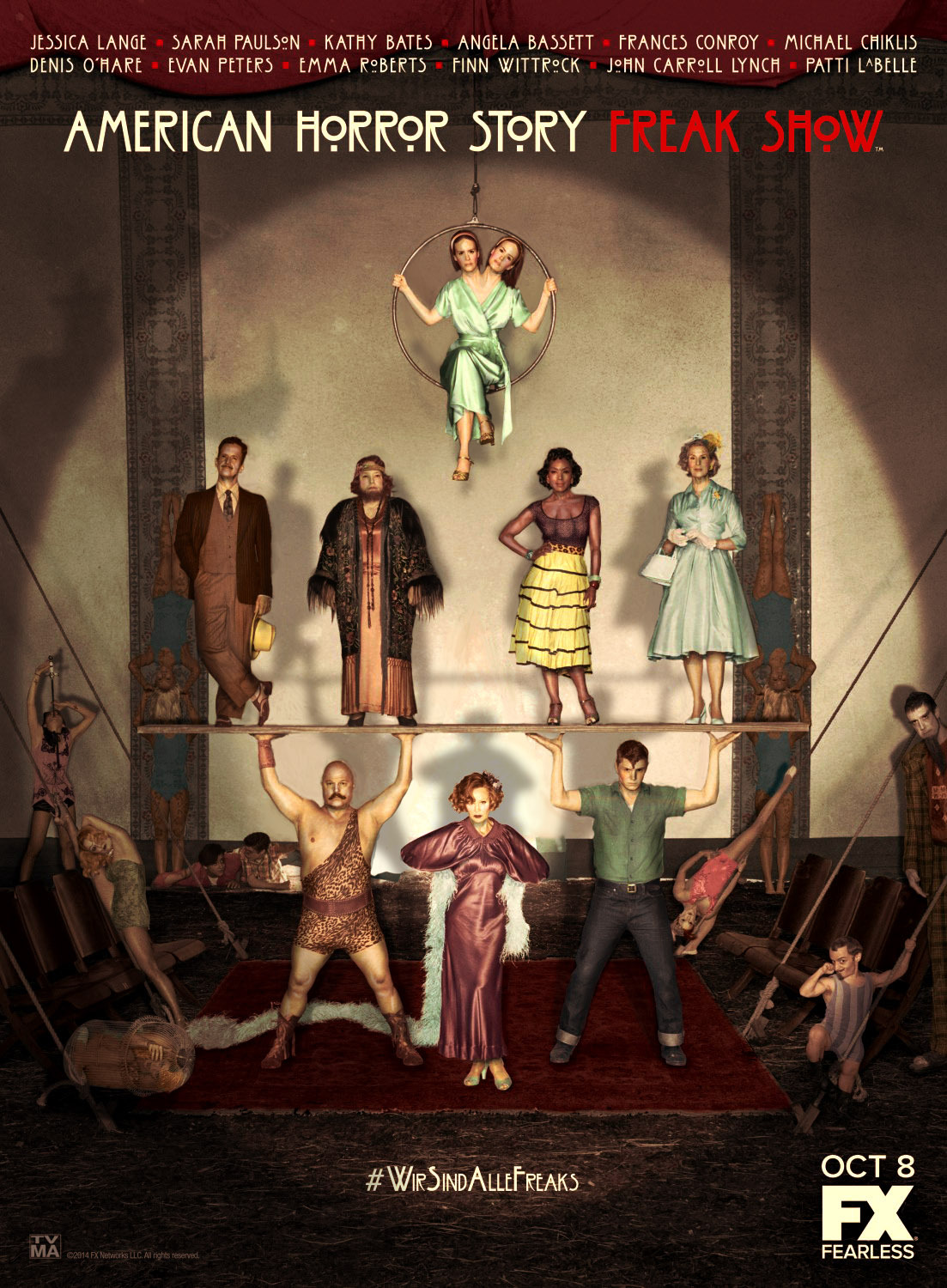
American Horror Story Freak Show
The new season of American Horror Story Freak Show was released last week and has dominated much social interaction. The show as a whole is very popular and appeals to a variety of audiences including the explorer and the aspirer. The explorer would really like this show because it deals with all kinds of warped and twisted themes as well as disabilities and ways of life, and is completely original and unlike any other on the TV currently. This show would also appeal to the aspirer because it is such a popular show and is much talked about. therefore the aspirer would watch it in order to join in with the conversations and give themselves status, which is what they strive for.
The new season has had much speculation about it's content because it has only ever had short 30 second teaser trailers released, which did not give much away about the plot, however it did give some if the characters 'freakish' qualities away. Because the whole season in it's self has had so little information given away about it, when it aired twitter exploded with comments about it, as the characters lives and stories were finally revealed to us with some shocking relationships. Also because of it's popularity and bizarre storyline and vague outline of the plot, many conversations have been had about where the rest of the story will go and how the characters will react, after knowing how the cast's previous characters have ended up. (In past seasons most of the same cast has been used, however each season there is a new story, therefore the actors get new characters)
The show also offered the audience entertainment and escape. This season is set in Jupiter, Florida in the 1950's. Not only does this show offer us a place very few of us have ever visited to give us a taste of the sights and views there, it also transports us into a new time with a way of life that we have heard about but very few have experienced. The show is set in a circus and follows the lives of the performers within it. This offers us escape from our own lives because many of us will never be able to experience life in a circus camp, in Florida and will never get to experience the 1950;s way of life. All of the escapes that this show provides also entertains us and interests us because it's a place and a time period that younger audience members may never get to visit and the will certainly not be able to experience it in the time period.
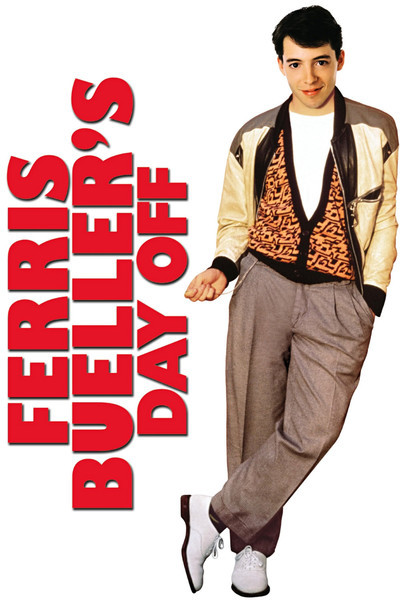
Ferris Bueller's Day Off
This week I also consumed was Ferris Bueller's Day Off, again.
The film itself came up through social interaction as I was having a conversation about the best films from the 80's and I suggested Ferris Bueller's Day Off because John Hughes has produced some of my favourite films from that era. Therefore I re-watched the film again.
The reason I love this film so much comes from the personal identification that we can all have with Ferris. He is witty, charming and inventive although these are qualities many of us poses, very few of us make use of them to the extent he does, for reasons we all relate to. In the film Ferris decides that the weather is far too nice to be going to school,so he drafts in his best friend and girlfriend to take the day off and cause comic mayhem in the city. In reality, in a situation like this most of us end up going to school where as in the film Ferris does not. We relate to his character because we wish we could be like him, that way we would be able to get away with bunking off school, making the most elaborate stories and dramas all so he can have a great time and get away with just bunking off school.
The film itself also offers escape, because it is set in America, which is a place I have never been. It's also set in the 1980's which is an era that I will never get to experience. This film offers the experiences of a new time period and a new country to audience members like myself. It also offers us experiences that we would probably never get to have, for example bunking off school and getting involved in a parade through the city.
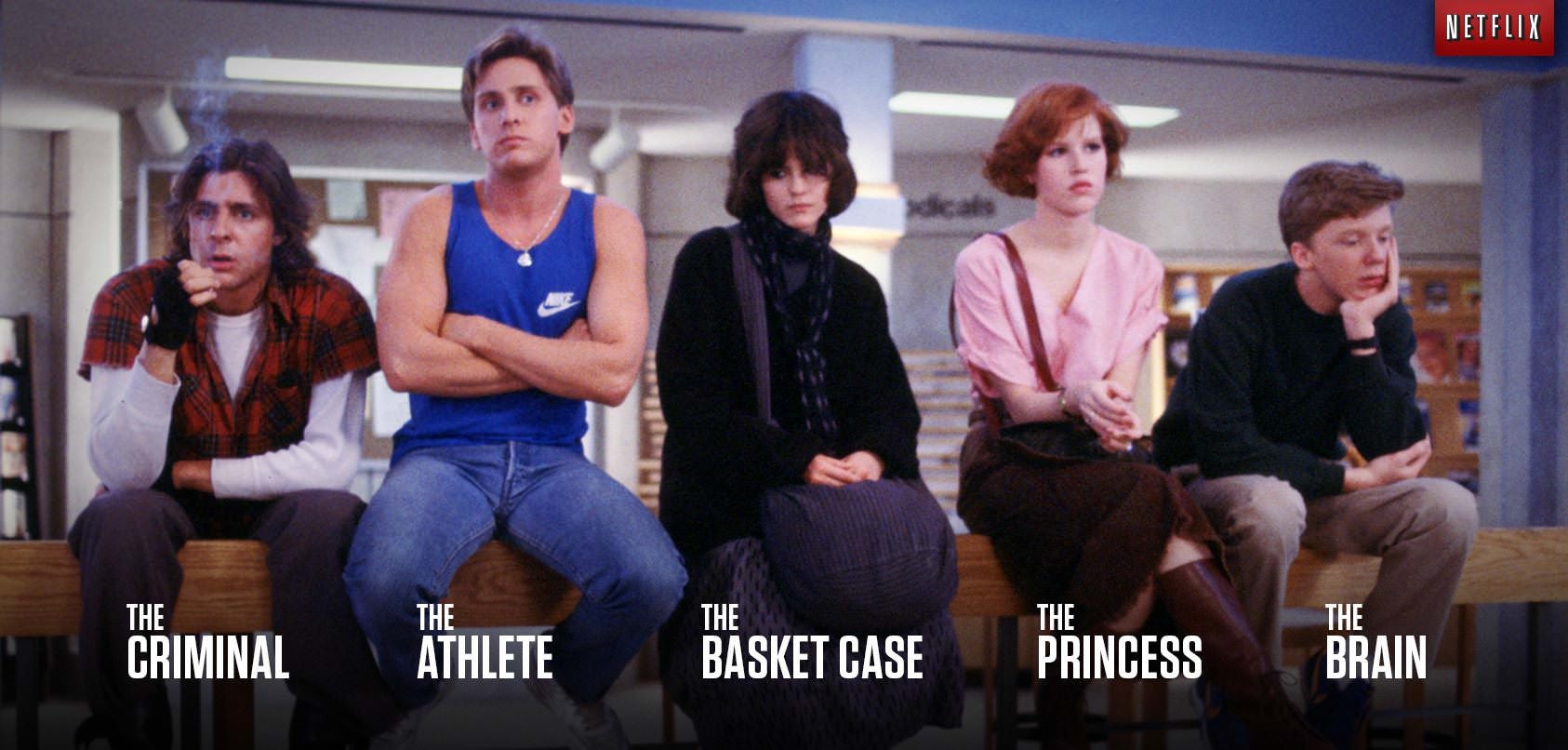
A film that has changed my life is The Breakfast Club, directed by John Hughes.
This film really engaged with me on an emotional level because it was easy to relate to. Although the setting is within a school the characters are all a similar age to myself and I found that I could relate to every one of them, because as the image shows above, each character ends up with a title that represents them, however there are certain elements from each individual character that I can relate to and so can many teenagers.
Bender, 'The Criminal' deals with many issues that many teenagers often deal with such as drugs and domestic violence. The fact he smokes and takes drugs is something many people often experience during their teenage years and is often something many are curious about. As well he comes from a violent background where his father often beats him and his mother, although this is an extreme case of domestic violence, it is also something which a lot of people have been exposed to at one point or another. Also the fact that the character of Bender is far from perfect and often finds himself in Mr Vernon's office is something which most teenagers can relate to since a majority of people have found them self being reprimanded by a teacher at some point, this allows the audience to engage with the character on a personal level.
Andy, 'The Athele' is a character that I could also relate to because he does not actually like sport or the lifestyle that comes with it. However he goes through with it to please he father, This is something I could relate to personally and many other teenagers could as well because he constantly tries to please others and puts off doing what he loves in order to gain praise and please them. Many would be able to identify with Andy Clark because they would only try to please others in order to have an easy life, despite being unhappy with their decision to go along with it.
Ally 'The Basket Case' is also a character that is easy to relate to because she sees herself as an outsider and someone that constantly has to lie in order to make herself seem interesting or fit to fit in. Being an outsider or an out cast is something many people feel like they are in school because they don't know where they fit in within the cliché hierarchy most schools have. Ally feels the need to lie to fit in, throughout the film she lies about things such as intimacy, which is something most people experience at different ages throughout their teenage life and also something which many feel they need to experience in order to 'fit in' or to feel 'normal'.
Claire 'The Princess' is a character that is easy to relate to as she is criticised throughout the film for being rich, having nice things and 'the perfect life' which is something the character of Bender, and many of the audience aspire to have, The fact that Claire does not appreciate the security she had with both parents and a rich lifestyle is something the audience can relate to because many people will know of someone who has everything we desire such as a complete stereotypical family, yet is still not happy. Also the fact that Claire is criticised for still being a virgin is something that many teenagers can relate to because she is then seen as 'frigid' and a 'tease'. Yet Ally who claims not to be a virgin is regarded as a 'slut'. This is a cliché high school topic and is something most teenagers feel uncomfortable about because either way, they will be judged by everyone else.
Brian, 'The Brain' is the stereotypical clever guy of the group, who does well in school, gets good grades yet is still judged by the rest of the school hierarchy for being a 'geek' or a 'nerd'. Brian is easy to relate to because he, like many others tries to ignore the criticisms of his peers and still continues life by trying not to get in the way of people like Bender. However, throughout the film Brian is subjected and succumbs to peer pressure and gets high by smoking marijuana, this is a rateable issue which many people throughput their teenage years will experience and try. This also goes against the cliché stereotype and exposes the true reality that in fact clever people aren't necessarily perfect either and they are just as curious to try potentially dangerous and new things such as drugs, as the 'criminals' would.
Throughout the whole film, Brian is the character I identify most with on a personal level because he studies hard and tries to do as well as he can, despite coming from a not-so-privileged background. I also identify with him the most because he would never treat any of his new friends that he meets in detention, differently when his actual friends simply because he has made a personal and emotional connection with them. Unlike both Andy and Claire, who openly admit that if Brian came up to them and their socially elite friends they would probably laugh at him.
Overall, The Breakfast Club is one of my favourite films simply because I can relate to every single one of the characters and their issues, and so can most teenage audiences, which the final quote of the film explains. Also it challenges the typical ideologies of rule breakers who flout rules and the way Mr Vernon sees all pupils, as well as conforming to the ideology that everyone is different and feels like an outcast sometimes, but that's okay, because underneath it all we are all the same anyway.
The master behind the masterpieces that are the mind bending Shallow Grave, Danny Boyle does not fail to impress with his new movie, yanking and shaking up the new generation with his epic Sci-Fi Thriller, Sunshine. It’s as twisted as Trainspotting and creepier than 28 Days later.
Like in his previous works the characters in Boyle’s film are trapped on a rapidly descending spiral. Set 50 years in the future, a small team of eight drift through space, strapped to a bomb with a mission to save Earth and reignite the sun after it begins to die. After discovering the remains of the first vessel that attempted the mission, Icarus I, the team decide to climb aboard so they can have two shots at reigniting the sun and save the earth, human race and any possible survivors. But in doing so they also unleash some incredibly dark forces that make us question our faith, religion, and provoke the cliché question, is there life beyond earth?
Starring Cillian Murphy (who also starred in Boyle’s 28 Days Later) Chris Evans and Rose Byrne, they provide captivating characters and a rather attractive and front for the film but the most impressive thing about the movie is definitely the CGI. It’s as futuristic, realistic and spellbinding as you can possibly get; with technology beyond the comprehension of anyone who hasn’t got a degree in computer stuff, a talking spaceship, floating spacemen, a burning sun and a Back to The Future inspired hover board, there is nothing in this film that makes you cringe or shield your eyes in shame like the special fx did in the early Doctor Who episodes. The acting of the cast are rather amazing, conveying panic, fear of the unknown and insanity perfectly, particularly from Murphy. Throughout the film, he’s often left with the final say on the decisions, particularly on the matters of life and death and you’re left thinking what you’d do in that situation.
However there is one problem. The protagonist. I kind of expected more from something that was supposed to be so evil rather than a rather blurry splodge that looks like it could be from the Claymation Morph. As well, why constantly cut the image of it? Throughout the vital scenes, the pinnacle moment of the film, why constantly cut peak moments. Okay, Capa (Murphy’s character) is supposedly running out of oxygen so is probably going to drift in and out of consciousness, but why in the most anticipated and dramatic pinnacle moments?
Overall, the film is an epic visual masterpiece that will leave you with more questions about life and space and religion than what you already have and a slight fascination with the sun. Danny Boyle triumphs with his signature mind-boggling tricks once again.
Rule of Thirds
This image applies to the Rule Of Thirds because it is clearly split up horizontally. The top third being the sky, the middle the sky and the lighthouse and the bottom being the sea. The focus point, the lighthouse, also sits on the intersecting line.
Foreground & Backgrund
This image has two points of interest. In the foreground the dog is clearly visible as is the San Francisco bridge in the background. This adds visual depth to the image because although the point of interest is the dog, the bridge is also in the shot, which shows the audience where the image was taken.
Lines & Shapes
This image shows how lines and shapes work together because the blurred car lights are line curved lines of light.
Light & Shade
Light and shade is used here to emphasise the romantic image of the couple through their shadow.The street is they are walking down is very light and their shadow contrasts with that, making that the focus and the most noticeable part of the image. The light and shade also adds dramatic effect because it's essentially black and white, which has connotations of old fashion ways. The couple themselves are walking closely side by side holding hands which also has connotation of old fashioned romanticism.